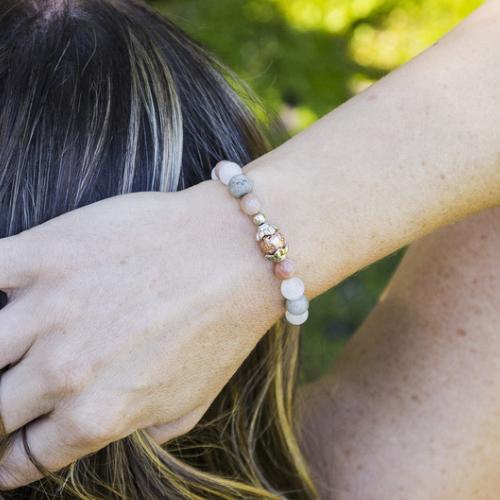




Mala Bracelet Meaning: A Quick Guide to 108 Beads and Meditation
Have you ever held a prayer in your hands? That’s the real heart of a mala bracelet’s meaning. It's so much more than a beautiful piece of jewelry; it's a sacred tool for meditation, a quiet anchor for mindfulness, and a personal touchstone for your intentions, with roots stretching back thousands of years.
Your Spiritual Compass for Inner Peace
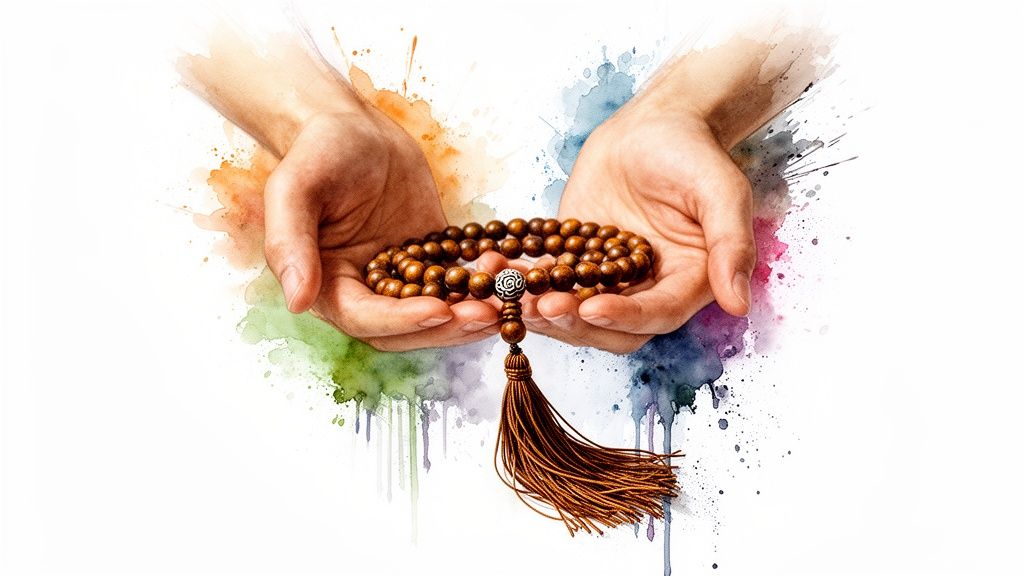
Think of your mala as a spiritual compass. In a world that constantly pulls your attention in a million different directions, it’s a tangible guide designed to steer your focus inward. It serves as a physical anchor for your mind, gently reminding you to return to a place of calm and presence.
Every single element is chosen not just for its beauty, but for its deep spiritual function. It becomes a wearable story—a quiet, personal reminder of your journey and the intentions you cherish most. This ancient tool for centering the mind is built from several key parts, each with its own layer of significance that creates a powerful loop of intention you can carry with you.
The Anatomy of a Mala Bracelet
To truly appreciate the depth of a mala, it helps to understand its parts. While you'll find countless beautiful designs, most traditional malas share a core structure that supports their meditative purpose. These elements work together seamlessly, turning a simple string of beads into a profound guide for your inner world.
A mala is more than just a collection of beads; it's a carefully constructed tool for mindfulness. Let's break down the essential parts to see how they come together.
The Anatomy of a Mala Bracelet at a Glance
| Component | Spiritual Function and Symbolism |
|---|---|
| 108 Beads | Represents the universe or the 108 energy lines converging at the heart. Used to count mantras, keeping the mind focused during meditation. |
| Guru Bead | The larger, central bead that signifies the student-teacher relationship, inner wisdom, and the culmination of a meditation cycle. |
| Tassel | Symbolizes our connection to the divine and to one another. It represents the journey from darkness to light, like a lotus flower rising from the mud. |
| Knots | The small knots between each bead secure the mala and create space for mindful counting. They symbolize the divine link connecting all things. |
Each component gives the mala its power, turning it from a simple accessory into a meaningful instrument for your spiritual practice. Now, let’s explore these parts a little more deeply.
- The 108 Beads: This sacred number holds immense significance, often representing the wholeness of the universe. In meditation, these beads become your guideposts, used to count mantras or breaths, which helps keep your mind from wandering off.
- The Guru Bead: This is the larger, central bead that marks the start and end of your meditation. It’s a beautiful symbol of the wisdom you receive from teachers and, most importantly, the inner guide you carry within yourself.
- The Tassel: The tassel is a powerful symbol of oneness and our connection to something greater. Its individual threads bind together to form a whole, representing the unity of all beings and the journey from the darkness of ignorance to the light of enlightenment.
A mala is not just an object; it is a vessel for your intention, a companion on your spiritual path, and a tangible link to a timeless tradition of inner exploration. It reminds you that peace is always within reach, one breath and one bead at a time.
By understanding the language of your mala, you unlock a much deeper relationship with your practice and, ultimately, with yourself. It transforms from a bracelet you wear into a story you live.
The Ancient Roots of Spiritual Beads
To really understand what a mala bracelet means, we need to take a journey back in time. This isn't some new wellness trend; it's a sacred tool with an ancient soul, born from our timeless search for inner peace and a connection to something greater. Its story is woven right into the fabric of Eastern spirituality.
It all started in ancient India, where these spiritual tools first came to be. They were never just simple jewelry. They were crafted for a profound purpose: to help with one of the hardest things we do as humans—quieting the ever-wandering mind.
A Garland for the Gods
The story of mala bracelets begins in the spiritual heartland of ancient India, with roots stretching as far back as the 8th century BCE. It was around this time that Hindu sadhus, or holy men, started using beads to keep their focus while meditating and reciting mantras. In fact, some of the earliest visual proof we have comes from ancient sandstone sculptures in India showing devotees praying to Lord Shiva with beads in hand.
The word 'mala' itself comes from Sanskrit and means 'garland.' The full term, 'japamala,' perfectly captures its function, as 'japa' means recitation. You can learn more about the fascinating history of mala beads and their incredible journey through time.
This simple yet brilliant tool allowed spiritual seekers to dive deep into their devotion without the distraction of counting prayers. Picture a yogi sitting in silent contemplation, each bead rolling through their fingers marking another sacred chant, another step inward. This was more than just counting; it was a rhythmic, physical anchor for the spirit.
A mala is a thread connecting the present moment to a lineage of seekers who have walked the path of mindfulness for thousands of years. When you hold one, you are holding a piece of that history.
This practice, born from a deep desire for truth and meaning, soon began to travel. Carried along ancient trade routes and whispered from one spiritual tradition to another, the mala started its journey across continents and cultures.
The Journey Across Asia
As Buddhism bloomed and spread from India, it took the mala with it. Monks and followers quickly adopted these sacred beads, weaving them into their own meditative practices. The mala became an essential companion on the path to enlightenment—a tangible reminder of the commitment to rise above worldly attachments and find inner peace.
This migration turned the mala from a largely Hindu tool into a universal symbol of spiritual dedication. Its journey continued through Tibet, China, and Japan, with each culture adding its own unique touch while holding on to the beads' core purpose.
- In Tibetan Buddhism, malas are deeply connected to powerful mantras and visualizations. They are often blessed in monasteries, believed to hold and amplify spiritual energy.
- In China, the practice influenced the prayer beads used in different schools of Buddhist thought, becoming a common sight in both temples and homes.
- In Japan, Buddhist temples ring bells 108 times on New Year's Eve in a tradition called Joya no Kane. This ritual is meant to cleanse the 108 earthly desires—a direct echo of the mala's sacred number.
From an ancient monastic practice to a cherished personal ritual, the mala's story is a beautiful testament to its enduring power. It evolved, adapted, and found a home in the hearts of millions, proving that the human need for a quiet anchor is truly universal.
So today, when you wear a mala bracelet, you’re connecting to this profound and unbroken lineage. It's a quiet nod to the wisdom passed down through generations—a timeless tradition of devotion, mindfulness, and the simple, sacred act of returning to yourself, one bead at a time.
The Sacred Rhythm of 108 Beads
Ever wonder why traditional mala bracelets always have 108 beads? It’s a question I get all the time, and the answer is truly beautiful. This isn't just an arbitrary number; it's the spiritual heartbeat of the mala, a sacred count that connects ancient wisdom, the vastness of the cosmos, and even our own bodies.
When you hold a 108-bead mala, you're not just holding a piece of jewelry. You're holding a symbolic map of the universe, a tool designed to bring your personal energy into alignment with a much larger, cosmic harmony. Understanding this number is the key to unlocking the true mala bracelet meaning.
The Spiritual Soul of 108
Across many Eastern traditions, the number 108 is a guidepost on the path to inner peace. Think of it as a framework for the spiritual journey, representing the challenges and milestones on the way to enlightenment.
-
Buddhist Wisdom: In Buddhism, it’s taught that there are 108 earthly temptations (kleshas) that cloud our minds and keep us from reaching nirvana. As you pass your fingers over each bead while reciting a mantra, you’re symbolically releasing one of these attachments. It’s a powerful, tangible act of purification.
-
The Yogi's Heart: Yogic philosophy tells us that 108 sacred energy lines, or nadis, converge to form the heart chakra. By chanting a mantra 108 times, you're believed to activate and cleanse this vital spiritual center, opening yourself up to deeper love, compassion, and connection.
So, the repetition isn't just about counting. It’s a mindful ritual that helps you work through the internal static, one bead and one breath at a time.
A Cosmic Connection
What’s truly mind-blowing is how the number 108 shows up not just in ancient texts, but in the sky above us. Early astronomers saw this number as a thread connecting our world to the divine, weaving it into the very fabric of our solar system.
The number 108 acts as a bridge, connecting the inner journey of meditation to the outer vastness of the cosmos. It reminds us that the same patterns that govern the stars and planets exist within our own hearts.
Consider this: the distance from the Earth to the Sun is about 108 times the Sun’s diameter. And the distance from the Earth to the Moon? You guessed it—roughly 108 times the Moon’s diameter. This incredible cosmic alignment is why the sun and moon appear to be the same size in our sky. It infuses the mala with the balanced, harmonious energy of the universe itself.
Ultimately, the number 108 elevates a simple string of beads into a profound tool for intention. It represents the full circle of our journey—from embracing our human imperfections to feeling our connection to the grand, rhythmic dance of the cosmos. Every time you complete a cycle of 108, you're not just meditating; you're taking part in a timeless ritual that aligns your inner world with the rhythm of the universe.
Choosing Gemstones to Shape Your Intention
Choosing a mala bracelet is a beautiful, intuitive moment where ancient wisdom meets your personal spiritual path. Each gemstone is far more than just a pretty stone; it's a tiny piece of the Earth, vibrating with its own unique energy and telling its own story. Think of it like tuning an instrument—you're looking for the exact frequency that resonates with the song in your soul.
This isn’t about just picking the most attractive design. It’s about pausing, listening to that quiet inner voice, and asking, "What energy do I truly need in my life right now?" Are you searching for a sense of calm amidst chaos? Courage to leap into a new chapter? Or perhaps a deeper connection to your own heart? The right gemstones can become powerful allies, amplifying your intentions and supporting you on your journey.
This very process bridges the gap between a heartfelt desire and a daily, tangible practice. The mala you choose becomes a wearable reminder of who you are and who you are becoming. It’s not just an accessory; it's a commitment to your own growth, a physical touchstone for the intention you carry with you.
Aligning Energy With Personal Goals
Every stone holds a unique energetic signature. Rose Quartz, for instance, pulses with the gentle, unconditional love that’s perfect for anyone working on self-acceptance or healing old emotional wounds. Tiger's Eye, on the other hand, radiates a fierce, protective energy, encouraging bold action and unwavering confidence. The real magic happens when you match a stone's inherent properties with what you want to cultivate in your own life.
This is where the true mala bracelet meaning comes alive—it transforms into a tool perfectly customized by your own purpose. To begin, take a quiet moment for honest self-reflection.
- What is your core intention? Try to pinpoint the one thing you want to focus on. It could be peace, clarity, strength, or creativity. Get as specific as you can.
- Trust your gut. As you browse different malas, which one are you instinctively drawn to? More often than not, the bracelet that catches your eye is the one holding the exact energy you need.
- Feel the color. A gemstone's color is deeply tied to its energetic properties and often corresponds to the body's chakras. If you're drawn to a particular hue, there's usually a reason. Deepening your knowledge by exploring chakra colors and their spiritual significance can add another layer of meaning to your choice.
Your intuition is your most reliable guide. The mala that catches your eye and feels right in your hands is often the one meant for you, carrying the exact energy you need to support your journey.
This intuitive process ensures your mala becomes more than just a beautiful object; it becomes a resonant partner in your spiritual practice.
A Guide to Gemstone Energies and Intentions
To help you get started, we’ve put together a quick guide to some of the most beloved gemstones used in malas and the intentions they are best known for supporting. Each one offers a unique gift and a different way to channel your focus. You can always explore our complete guide to discover the unique gemstone bracelet meaning behind every crystal.
Discover the unique energetic properties of popular gemstones to find the perfect mala bracelet for your spiritual journey.
| Gemstone | Primary Energy | Best for Setting Intentions Of... |
|---|---|---|
| Amethyst | Spiritual Insight & Calm | Deepening meditation, enhancing intuition, and connecting with inner wisdom. |
| Rose Quartz | Unconditional Love | Healing the heart, fostering compassion, forgiveness, and gentle self-love. |
| Black Onyx | Grounding & Protection | Shielding from negativity, building inner strength, and staying centered. |
| Howlite | Patience & Peace | Reducing stress and anxiety, calming an overactive mind, and promoting rest. |
| Tiger's Eye | Courage & Confidence | Taking bold action, overcoming fear, and manifesting personal power. |
| Lapis Lazuli | Truth & Awareness | Speaking your truth with clarity, enhancing self-awareness, and seeking knowledge. |
Ultimately, the best mala for you is the one that speaks directly to your soul. This is your journey, and your choice is a powerful first step.
The number 108 is also profoundly significant in a mala's design, connecting the universe, the body, and the spirit. This diagram shows just how deep those connections run.
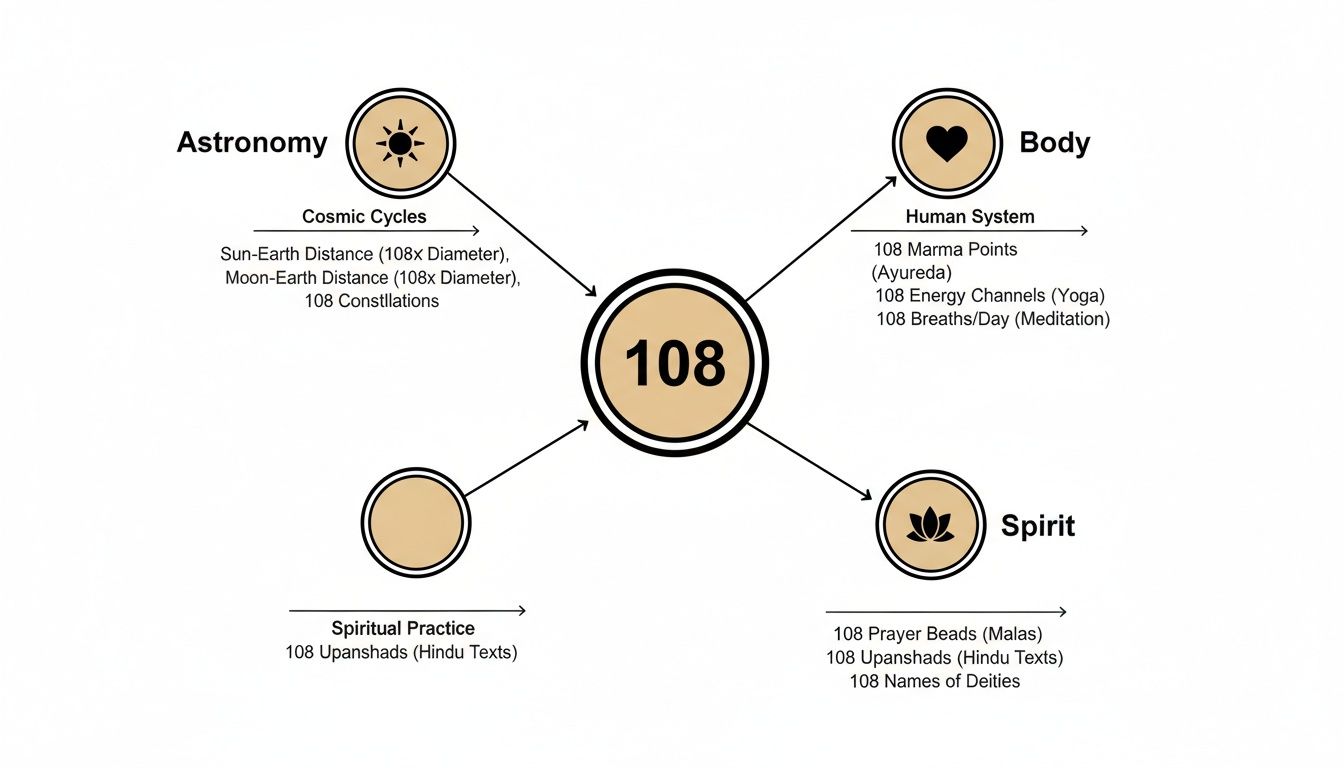
It’s a beautiful reminder that this sacred number creates a bridge between our inner world and the cosmos, reinforcing the deep, multi-layered meaning of every mala.
Whether you find yourself drawn to the fiery confidence of Tiger's Eye or the tranquil peace of Howlite, let your choice be a true reflection of your deepest desires. This intentional selection is what transforms your bracelet from a simple string of beads into a powerful and deeply personal spiritual tool.
How to Use a Mala for Meditation and Mindfulness
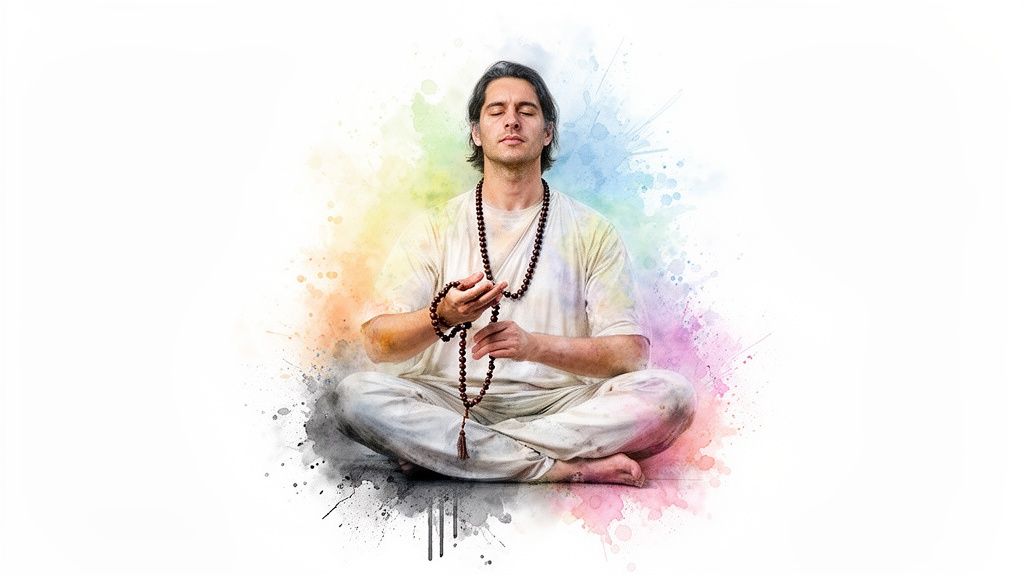
Your mala is so much more than a beautiful story on your wrist. Its true power awakens when you invite it into your inner world, transforming it from jewelry into a potent tool for finding stillness. The ancient practice of Japa meditation is a simple, rhythmic way to calm the endless chatter of your mind and connect with your deepest intentions, and your mala is the perfect guide for the journey.
Think of it as training for your focus. The tactile sensation of moving from one bead to the next gives your wandering mind a physical anchor, making it easier to gently pull your awareness back to the present moment. This simple act builds a bridge between your inner world and your outer actions, infusing your entire day with a quiet sense of purpose.
Getting Started with Japa Meditation
Japa meditation is a wonderfully accessible practice, whether you're a seasoned meditator or just starting out. It’s all about the rhythmic repetition of a mantra—a sacred sound, word, or phrase—while using the beads to keep a steady count. This simple combination creates a deeply immersive state that helps quiet all that mental noise.
Ready to begin? Here’s a simple guide to get you started:
- Find a Quiet Space: Settle into a comfortable seated position, either on a cushion or a chair. Make sure your spine is straight, and take a few deep, cleansing breaths to ground yourself.
- Set Your Intention: Hold your mala in both hands and take a moment to set an intention for your practice. What energy do you want to call in? Maybe it's peace, clarity, or a sense of gratitude.
- Hold Your Mala Correctly: Drape the mala over the middle finger of your right hand. You'll use your thumb to gently pull each bead toward you as you repeat your mantra.
- Begin at the Guru Bead: Start with the bead right next to the larger guru bead. As you hold this first bead, recite your chosen mantra, either aloud or silently to yourself.
- Move Bead by Bead: After one full recitation, use your thumb to pull the next bead toward you and repeat the mantra. Continue this flow, one bead and one mantra at a time, until you've made your way all around the loop.
- Pause and Reflect: When you reach the guru bead again, you've completed 108 repetitions. The tradition is to never cross over the guru bead. Instead, you can pause to reflect, offer gratitude, or, if you wish to continue, simply turn the mala around and head back in the opposite direction.
This ancient practice of using prayer beads is a thread woven deeply into our global spiritual fabric. It’s amazing to think that over two-thirds of the world's population—around 5.6 billion people—participate in prayer bead traditions that trace their roots back to the original mala. Originating in India as Hindu japamalas, the practice spread through Buddhism and eventually influenced Christianity’s rosary and Islam’s tasbih.
Choosing Your Mantra
A mantra is the very heartbeat of your meditation. It doesn't have to be complicated; it can be a traditional Sanskrit chant or a simple, affirming phrase in English that truly resonates with your soul.
Your mantra is a seed of intention you plant in your consciousness. With each repetition, you are nurturing it, helping it to grow and manifest in your life.
Here are a few beautiful mantras to get you started:
- "Om Shanti" (a classic chant for peace)
- "I am present"
- "I am calm and centered"
- "So Hum" (a powerful mantra meaning "I am that")
Your Daily Mindfulness Anchor
Beyond your formal meditation time, your mala serves as a constant, gentle reminder of your intention throughout the day. Just glancing at it on your wrist can be a powerful cue to pause, take a deep breath, and reconnect with your purpose. It's a simple way to weave mindfulness into the fabric of your life, effortlessly.
Many people find that making their mala part of a daily ritual creates the same kind of structured peace they feel in dedicated yoga sessions, which only deepens their spiritual practice. To take it a step further, check out our guide on combining crystals and meditation to truly elevate your mindfulness routine.
Caring for Your Sacred Mala Bracelet
Just like we need to recharge our own batteries, your mala bracelet needs a little TLC to keep its energy clear and bright. Think of the gemstones as tiny energetic sponges. As you go about your day, they naturally absorb all sorts of vibrations from the world around you, and without a regular cleanse, they can start to feel a bit heavy.
Taking the time to care for your mala is a beautiful ritual in itself. It's an act of respect for this sacred tool and a way to deepen your own connection to it. When you clear away old, stagnant energy, you're essentially hitting the reset button, making your mala ready to support you with its purest and most potent vibrations.
Gentle Cleansing Methods for Your Mala
You don't need anything complicated to give your mala an energetic refresh. The most effective methods are often the simplest, drawing on the power of nature to restore balance. What matters most is your intention—approaching the process with a sense of reverence for your beads.
Here are a few of my favorite ways to cleanse a bracelet:
- Moonlight Bath: There's something truly magical about the soft glow of the moon. Its gentle, feminine energy is perfect for clearing and recharging crystals. Just lay your mala on a windowsill or outside overnight, especially during a full moon, and let it soak in the beautiful lunar light.
- Smoke Cleansing: The aromatic smoke from sacred plants like sage or palo santo is a timeless way to neutralize unwanted energy. Simply light your sage bundle or palo santo stick, gently blow out the flame, and waft the cleansing smoke over and around your mala for about 30 seconds.
- Sound Healing: Energy is vibration, and you can use sound to break up any energetic funk. The resonant tones from a singing bowl, tingshas, or even a simple chime can do wonders. Place your mala nearby and let the sound waves wash over it for a few minutes.
Cleansing your mala is an act of reciprocity. As it supports your energy, you in turn care for its energetic well-being, creating a harmonious and powerful partnership on your spiritual path.
Renewing Your Intention After Cleansing
After your mala feels fresh and clear, there’s one final, beautiful step: setting your intention. This is how you re-infuse the beads with your purpose and align them with where you are right now on your journey. It’s like breathing new life and direction into your spiritual companion.
Hold the cleansed mala in your hands. Close your eyes, take a deep, centering breath, and feel its energy. You can speak your intention aloud or just think it silently, infusing the beads with your desire. It might be a single word like “clarity,” or a personal mantra like “I walk my path with confidence and peace.” This simple act makes the mala truly yours again.
If you want to dive deeper, we've put together a complete guide on how to cleanse a crystal bracelet to keep its energy sparkling.
Got Questions About Mala Bracelets? We’ve Got Answers.
As you start to weave a mala into your daily life, it's totally normal for questions to pop up. This is a practice with deep roots and a lot of heart, and figuring out the little details can make your experience that much richer. Let's dive into some of the things people often wonder about when they first discover the meaning behind mala bracelets.
Think of this as a conversation with a friend who's been on this path for a while. Our goal is to give you the clarity and confidence to make your mala more than just an accessory, but a true companion on your journey.
Can Anyone Wear a Mala Bracelet?
Yes, absolutely. Malas may come from ancient traditions like Hinduism and Buddhism, but today, they're seen as a universal tool for anyone looking to find a little more mindfulness and set clear intentions in their life. You don't need to subscribe to any particular faith to feel the grounding, calming benefits of a mala.
At its core, a mala is a personal guide for your inner world. The only real requirement is to wear it with respect for its history and an appreciation for what it represents—a tool for peace, focus, and connection. It’s an open invitation to anyone and everyone.
What Should I Do If My Mala Breaks?
It can be a little startling when a mala you love breaks, but many traditions view this as a powerful and positive sign. A broken mala is often seen as a symbol of a breakthrough. It means a cycle has been completed, or the intention you set with that mala has been fulfilled.
A broken mala isn't an end—it's a beautiful completion. It’s a sign that you’ve absorbed its energy and are ready for the next chapter of your growth. It’s a moment for gratitude.
Instead of feeling a sense of loss, take a moment to reflect. Thank the beads for the support they've given you. From here, you have a choice: you can lovingly restring them, maybe with a new guru bead to mark your new beginning, or you can retire them and choose a new mala that resonates with where you are now.
Which Wrist Should I Wear My Mala On?
There aren't any hard-and-fast rules here, but tradition does offer some gentle suggestions that can deepen your connection. Most people find wearing their mala on their non-dominant wrist feels the most natural, as it’s less likely to get in the way of daily tasks.
From an energetic perspective, the left side of the body is often thought of as our "receiving" side. Wearing your mala on your left wrist is believed to help you soak up the unique energies of the gemstones. On the other hand, when you're actively using your mala for Japa meditation, it's traditionally held in the right, or "giving," hand.
Ultimately, listen to your own intuition. The best wrist is the one that feels right and energetically aligned for you.
At Evolve Mala, every single bracelet is handcrafted to be a beautiful and powerful companion for your spiritual path. Find the mala that speaks to your soul and begin your journey today. Explore our collection at https://evolvemala.com.